
NASA and FAA announce design competition winners
Hokies, Loughborough team to take top prize
First place was presented to a 28-student team from Virginia Tech, Blacksburg, and its collaborating partner, Loughborough University, Leicestershire, United Kingdom. The award provides $3,000 to Virginia Tech's design team members and a $5,000 award to Virginia Tech's Department of Aerospace and Ocean Engineering.
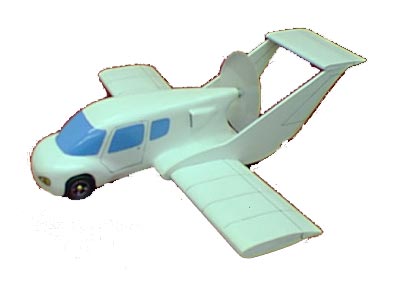
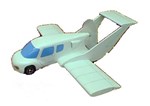
Dubbing its design "Pegasus," the team undertook the challenge of designing an aircraft that would be "roadable" – capable of both ground and air travel. The ability to switch from aircraft to car-like operation allows such a vehicle to effectively utilize small airports. The team recognized that the cost to actually produce such an aircraft would exceed today's typical general aviation aircraft cost. The students believed, however, that the additional cost should readily be offset by the convenience of not needing a car for ground transportation.
Boilermakers take second
Second-place honors went to a seven-student team from Purdue University, West Lafayette, IN, for the "Silairus 490," a six-passenger, high-performance piston engine aircraft with an Air Cushion Landing System (ACLS) in lieu of traditional landing gear. The design offers the capability of surface-independent takeoff and landing, permitting the vehicle to access off-airways communities, thus shortening door-to-door travel time. The Silairus 490 features a high-tech, electronically data-linked cockpit with a comfortable cabin adaptable for many client applications. The second place award provides a $2000 prize to the student team.
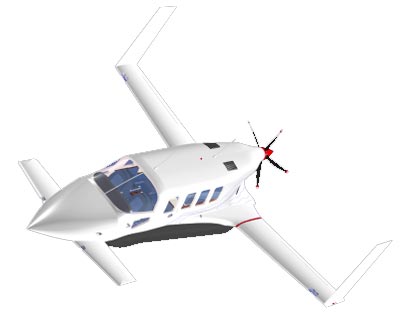
The Purdue team also won the Best Use of Air-Force-Developed Technology award for its incorporation of the ACLS, developed by the United States Air Force. For this award, the team will share a $3,000 prize from the Air Force.
Penn State team nabs third
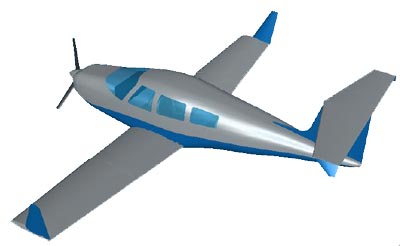
Third place was awarded to Pennsylvania State University, University Park. The team's design, called "Alnighter," is a modern, composite general aviation aircraft. The six-place, single-engine, propeller-driven vehicle has a conventional layout. It features sophisticated aerodynamics and advanced systems and avionics. For third place, the ten-student team will share a $1,000 prize. Penn State has the distinction of having won a place-award in each year of the competition.
Oklahoma wins retrofit award
The Best Retrofit Design Award was presented to a four-student, University of Oklahoma, Norman, team for development of an innovative, multi-mode tuned-exhaust system that offers noise reduction while improving the airplane's performance. The design was undertaken as a part of a larger aircraft design project to show how an older aircraft can be retrofitted with more modern technologies for increased performance and safety. The award's sponsor, the Aircraft Owners and Pilots Association Air Safety Foundation, presented $500 to the student team.
Now in its sixth year, the competition calls for individuals or teams of undergraduate and graduate students from U.S. engineering schools to participate in a major national effort to rebuild the U.S. general aviation sector. For the purpose of the contest, general aviation aircraft are defined as single or twin engine (turbine or piston), single-pilot, fixed-wing aircraft for 2 to 6 passengers. The competition seeks to raise student awareness of the importance of general aviation by having the students address design challenges for a small aircraft transportation system. NASA and the FAA hope to stimulate breakthroughs in technology and their application in the general aviation marketplace.
The Virginia Space Grant Consortium manages the competition for NASA and the FAA. Guidelines can be requested from msandy@odu.edu or at 757-865-0726.
Edited by Bob Arguero, Managing Editor, GovCon